
From Field Notes to Herbarium Sheets: Chasing the World’s Smallest Forests
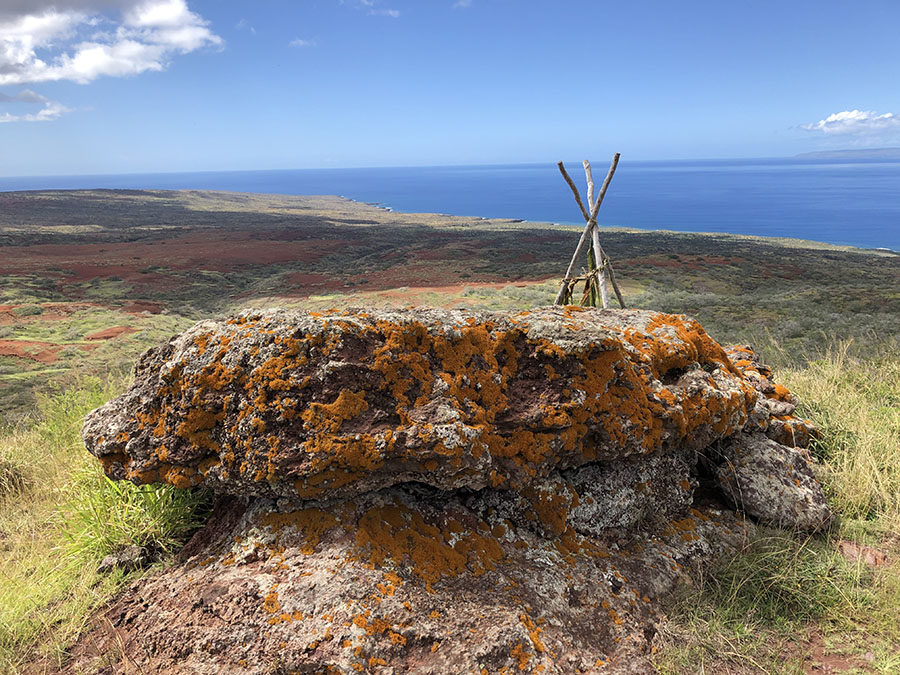
Graduate student Cuyler Bleecker is having a good ol’ time exploring liverworts of the smallest forests in his home of Hawaiʻi and for his M.S. studies here at the University of Alaska Fairbanks. He contributed to recent bryological research in Hawaiʻi that has significantly expanded knowledge of liverwort diversity, documenting 30 new island records and seven species newly recorded for the state, published here. A notable contribution is the first documented liverwort from Kahoʻolawe, based on field observations and photographic documentation of Frullania sandvicensis by Cuyler made in 2022, filling a major biogeographic gap for Hawaiian bryophytes and demonstrating the persistence of native cryptogams on a heavily degraded island.

Figure 1. Cuyler with his field assistant. Wet mount of Frullania sandvicensis Ångstr. at the Summit of Kahoʻolawe, 2022; note inflated, helmet-shaped lobules.
Cuyler is now continuing this work as a graduate student at the University of Alaska Fairbanks, where his research on bryophilous fungi highlights the hidden biodiversity associated with liverworts and the ascomycetes that inhabit these liverworts. His work involves surveying hundreds of herbarium specimens of the liverwort Gymnomitrion and looking for fungi parasitizing these small forests and making wet mounts of the asci and other characters of taxonomic utility, already discovering several taxa new to science. As noted in his recent publication, “bryophyte herbarium material often contains inadvertently collected fungal taxa that remain undocumented,” underscoring the value of both field surveys and historical collections for conservation and biodiversity discovery. Together, these efforts emphasize liverworts as reservoirs of cryptic diversity and as important indicators of remnant native ecosystems across the Pacific and boreal regions.

Figure 2. Dr. Peter Döbbeler, researcher at LMU in Munich and world authority on bryophilous fungi
This research was sparked from my sabbatical stay at Ludwig-Maximilians-Universität München in 2013 when one day Dr. Peter Döbbeler, the world authority of bryophilous fungi, talked to me that I should pursue studying these fascinating interactions between bryophytes and fungi in Alaska. Little did I know that 12 years later a fabulous student would enter my lab eager for a research project. Fast forward to 2025 and Cuyler has published his first paper on Gymnomitrion, and has obtained a large set of specimen loans from across the world to characterize the fungi on this liverwort and further infer phylogenetic relationships within Gymnomitrion and associated ascomycetes.

Figure 3. Some bryophilous ascomycete associates of Gymnomitrion concinnatum (Lightf.) Corda on host specimens from the ALA herbarium. A, C, & D) Epibryon cf caeserii (Bub. & Gz. Frag.) Döbbeler (D:
several fruitbodies on host shoots; A: stacked image of intracellular hyphae on host leaf fragment; C:
stacked image of a fruitbody (perithecium) with abundant bristles); B) Scanning electron micrograph of a
cluster of fruitbodies of Bryobroma gymnomitrii (Döbbeler) Döbbeler on host branch axil – the first
record outside of Europe was recently documented for this species (Greiff et al., 2024); E) subcuticular
hyphae, ruptured fruitbodies and liberated 1-septate, muriform ascospores (indicated by arrow) of
Bryochiton microscopicus Döbbeler. Host accessions: B36584 (A & D); B35845 (B); B37963 (C); and
B37111 (E). Scalebars: A, C, E) 20 μm (microns); B) 200 μm (0.2 mm); D) 1 mm.
Citations:
Greiff, G.R. L., Cuyler Bleecker, W., Haldeman, M., Slade, K., Smith, N., & Ickert-Bond, S.M. (2024). Utilising bryophyte herbarium material as a source of fungal novelty: A case study presenting new records of Bryobroma gymnomitrii (Döbbeler) Döbbeler on Gymnomitrion Corda in Britain and North America. Journal of Bryology, 46(3), 215–222. [Link]
Judziewicz, E.T., Freire, V.A., Pezillo, Z., Faccenda, K., Christianson, P., Fawcett, S. & Cuyler Bleecker. (2025). More Hawaian bryophye records from Herbarium Pacificum for 2025: 30 new island records including seven new state records for Hawaiian liverworts and hornworts. Records of the Hawaii Biological Survey for 2025. Evenhuis, N.L. Bishop Museum Occasional Papers 163: 131–147 (2025). [Link]

